Chapter 4 03-Sleep
4.1 Chapter introduction
This chapter analyzes a dataset examining whether different exercise routines are associated with improvements in sleep. Using data cleaning, merging, descriptive statistics, visualizations, t-tests, and one-way ANOVA with post-hoc comparisons, I evaluate changes in sleep duration (post–pre) and sleep efficiency across exercise groups. This provides practice working with real-world messy inputs, reproducible workflows, and interpreting statistical results.
file_path <- "C:/Users/laura/OneDrive/Desktop/real_bookdown/midterm_sleep_exercise.xlsx"
participant_info <- read_xlsx(file_path, sheet = "participant_info_midterm")
sleep_data       <- read_xlsx(file_path, sheet = "sleep_data_midterm")

participant_info <- clean_names(participant_info)
sleep_data       <- clean_names(sleep_data)

head(participant_info)
## # A tibble: 6 × 4
## id exercise_group sex age
## <chr> <chr> <chr> <dbl>
## 1 P001 NONE Male 35
## 2 P002 Nonee Malee 57
## 3 P003 None Female 26
## 4 P004 None Female 29
## 5 P005 None Male 33
## 6 P006 None Female 33## # A tibble: 6 × 4
## id pre_sleep post_sleep sleep_efficiency
## <chr> <chr> <dbl> <dbl>
## 1 P001 zzz-5.8 4.7 81.6
## 2 P002 Sleep-6.6 7.4 75.7
## 3 P003 <NA> 6.2 82.9
## 4 P004 SLEEP-7.2 7.3 83.6
## 5 P005 score-7.4 7.4 83.5
## 6 P006 Sleep-6.6 7.1 88.54.2
merged_data <- left_join(participant_info, sleep_data, by = "id") %>%
  mutate(
    sex = case_when(
      tolower(sex) %in% c("female","fem","f","femalee") ~ "Female",
      tolower(sex) %in% c("male","mal","m","malee") ~ "Male",
      TRUE ~ NA_character_
    ),
    exercise_group = case_when(
      str_detect(tolower(exercise_group), "c\\+w|cw") ~ "C+W",
      str_detect(tolower(exercise_group), "cardio") ~ "Cardio",
      str_detect(tolower(exercise_group), "weights|weight") ~ "Weights",
      str_detect(tolower(exercise_group), "none") ~ "None",
      TRUE ~ exercise_group
    ),
    age = as.numeric(age),
    pre_sleep = as.numeric(str_extract(pre_sleep, "\\d+\\.\\d+")),
    post_sleep = as.numeric(post_sleep),
    sleep_difference = post_sleep - pre_sleep,
    agegroup2 = case_when(
      age < 40 ~ "<40",
      age >= 40 ~ ">=40",
      TRUE ~ NA_character_
    )
  ) %>%
  filter(!is.na(sleep_difference))

knitr::kable(table(merged_data$exercise_group),
caption = "Number of participants in each exercise group.")| Var1 | Freq |
|---|---|
| C+W | 3 |
| Cardio | 34 |
| N | 2 |
| None | 15 |
| Weights | 19 |
| Var1 | Freq |
|---|---|
| Female | 40 |
| Male | 33 |
knitr::kable(table(merged_data$agegroup2),
caption = "Number of participants by age group (<40 vs ≥40).")| Var1 | Freq |
|---|---|
| <40 | 57 |
| >=40 | 16 |
4.3
##    Min. 1st Qu.  Median    Mean 3rd Qu.    Max.
## -1.1000  0.3000  0.8000  0.6822  1.1000  2.0000
overall_summary <- merged_data %>%
summarise(
mean_sleep_diff = mean(sleep_difference),
sd_sleep_diff = sd(sleep_difference),
min_sleep_diff = min(sleep_difference),
max_sleep_diff = max(sleep_difference),
mean_sleep_eff = mean(sleep_efficiency),
sd_sleep_eff = sd(sleep_efficiency),
min_sleep_eff = min(sleep_efficiency),
max_sleep_eff = max(sleep_efficiency)
)
knitr::kable(overall_summary, digits = 2,
caption = "Overall descriptive statistics for sleep difference (post–pre) and sleep efficiency.") | mean_sleep_diff | sd_sleep_diff | min_sleep_diff | max_sleep_diff | mean_sleep_eff | sd_sleep_eff | min_sleep_eff | max_sleep_eff |
|---|---|---|---|---|---|---|---|
| 0.68 | 0.63 | -1.1 | 2 | 84.16 | 5.98 | 71.7 | 101.5 |
group_summary <- merged_data %>%
group_by(exercise_group) %>%
summarise(
mean_sleep_diff = mean(sleep_difference),
sd_sleep_diff   = sd(sleep_difference),
mean_sleep_eff  = mean(sleep_efficiency),
sd_sleep_eff    = sd(sleep_efficiency),
n = n()
)
knitr::kable(group_summary, digits = 2,
caption = "Descriptive statistics for sleep difference and sleep efficiency by exercise group.")| exercise_group | mean_sleep_diff | sd_sleep_diff | mean_sleep_eff | sd_sleep_eff | n |
|---|---|---|---|---|---|
| C+W | 1.10 | 0.10 | 90.23 | 3.76 | 3 |
| Cardio | 0.97 | 0.44 | 86.56 | 5.94 | 34 |
| N | 0.30 | 0.85 | 81.30 | 0.28 | 2 |
| None | 0.09 | 0.64 | 81.37 | 6.10 | 15 |
| Weights | 0.61 | 0.60 | 81.43 | 3.92 | 19 |
4.4
ggplot(merged_data, aes(x = exercise_group, y = sleep_difference, fill = exercise_group)) +
  geom_boxplot() +
  labs(title = "Sleep Improvement by Exercise Group",
       x = "Exercise Group", y = "Sleep Difference (Post - Pre)") +
  theme_minimal() +
  theme(legend.position = "none")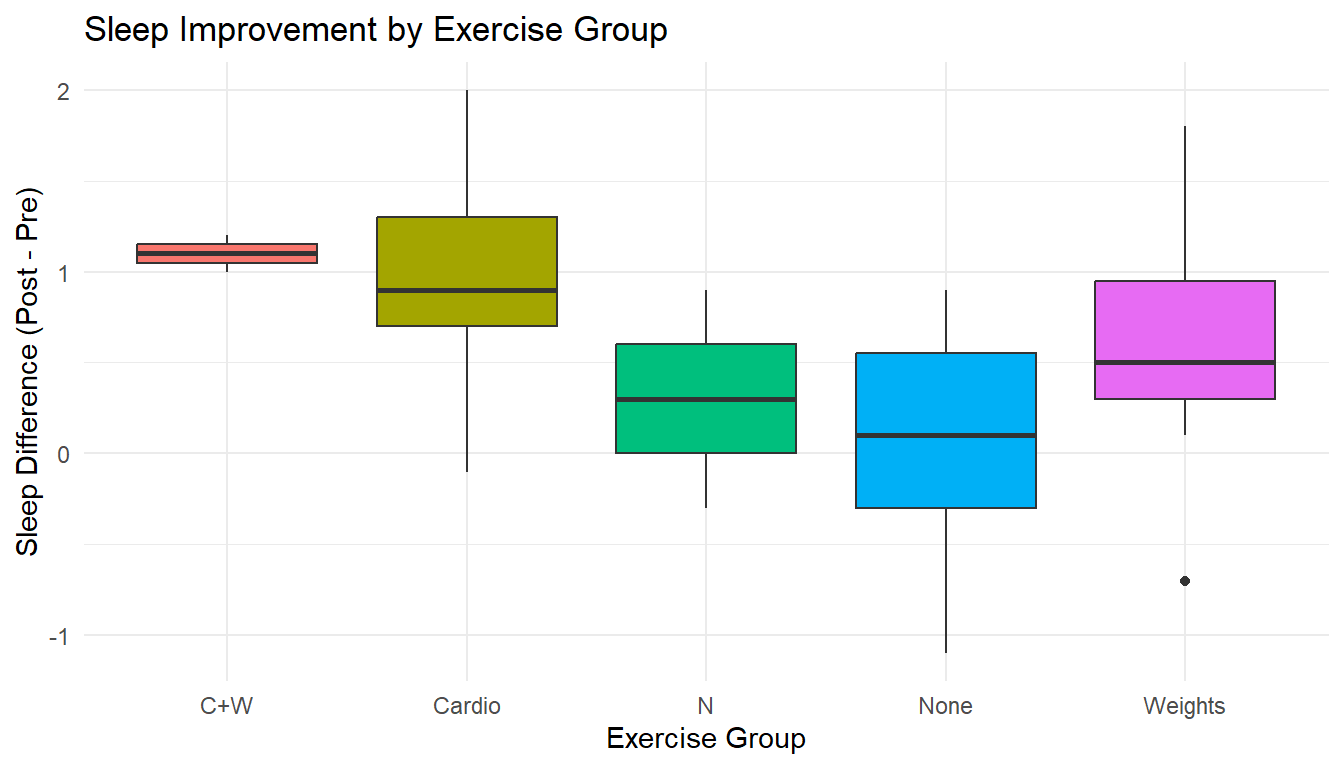
Figure 4.1: Boxplots of sleep improvement (post–pre) across exercise groups. This visual compares typical improvement and variability by exercise condition.
ggplot(merged_data, aes(x = exercise_group, y = sleep_efficiency, fill = exercise_group)) +
geom_boxplot() +
labs(title = "Sleep Efficiency by Exercise Group",
x = "Exercise Group", y = "Sleep Efficiency (%)") +
theme_minimal() +
theme(legend.position = "none")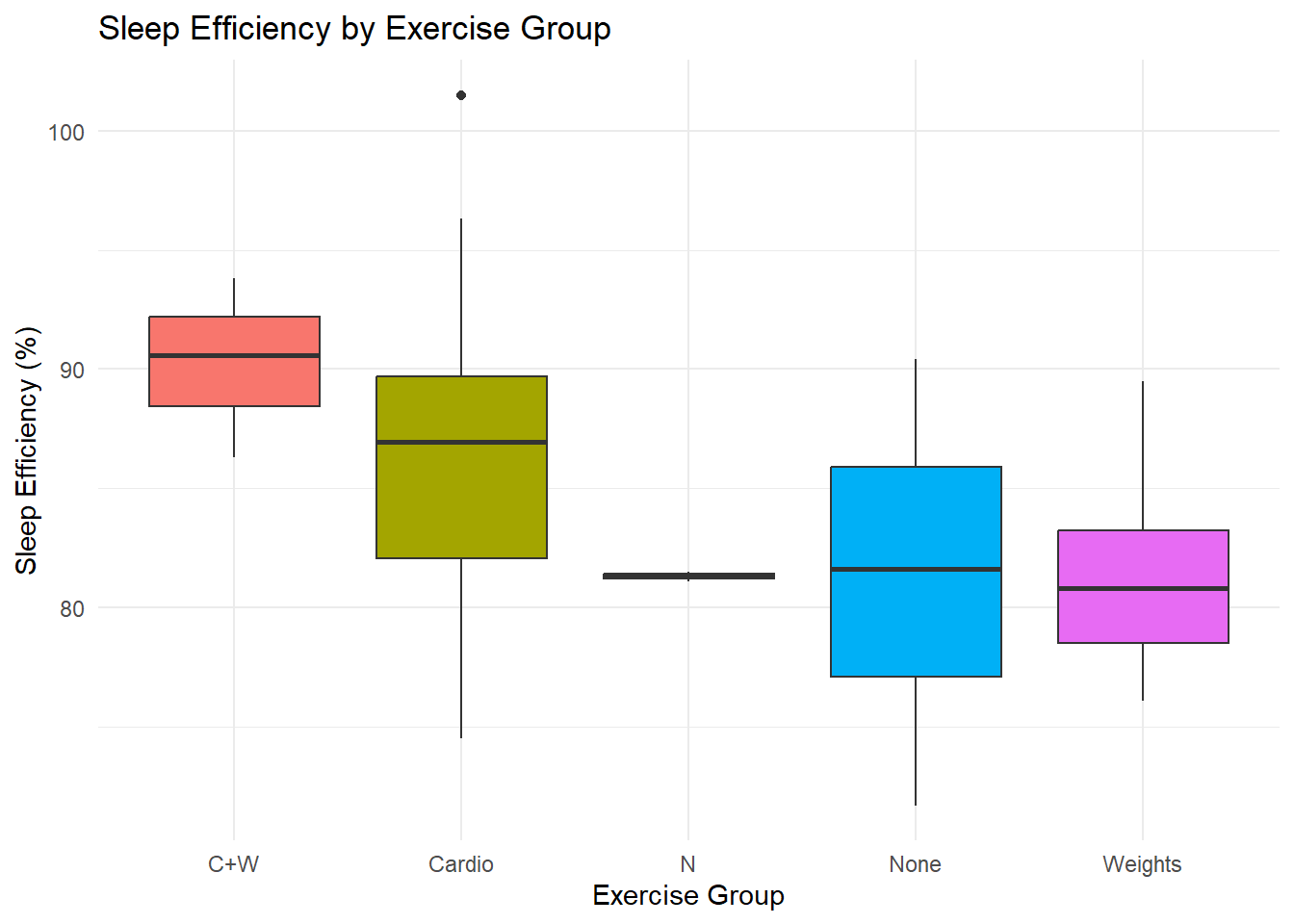
Figure 4.2: Sleep Efficiency by Exercise Group
ggplot(merged_data, aes(x = sleep_difference, y = sleep_efficiency)) +
geom_point(color = "blue") +
geom_smooth(method = "lm", se = FALSE, color = "red") +
labs(title = "Relationship Between Sleep Improvement and Sleep Efficiency",
x = "Sleep Difference (Post - Pre)", y = "Sleep Efficiency (%)") +
theme_minimal()
## `geom_smooth()` using formula = 'y ~ x'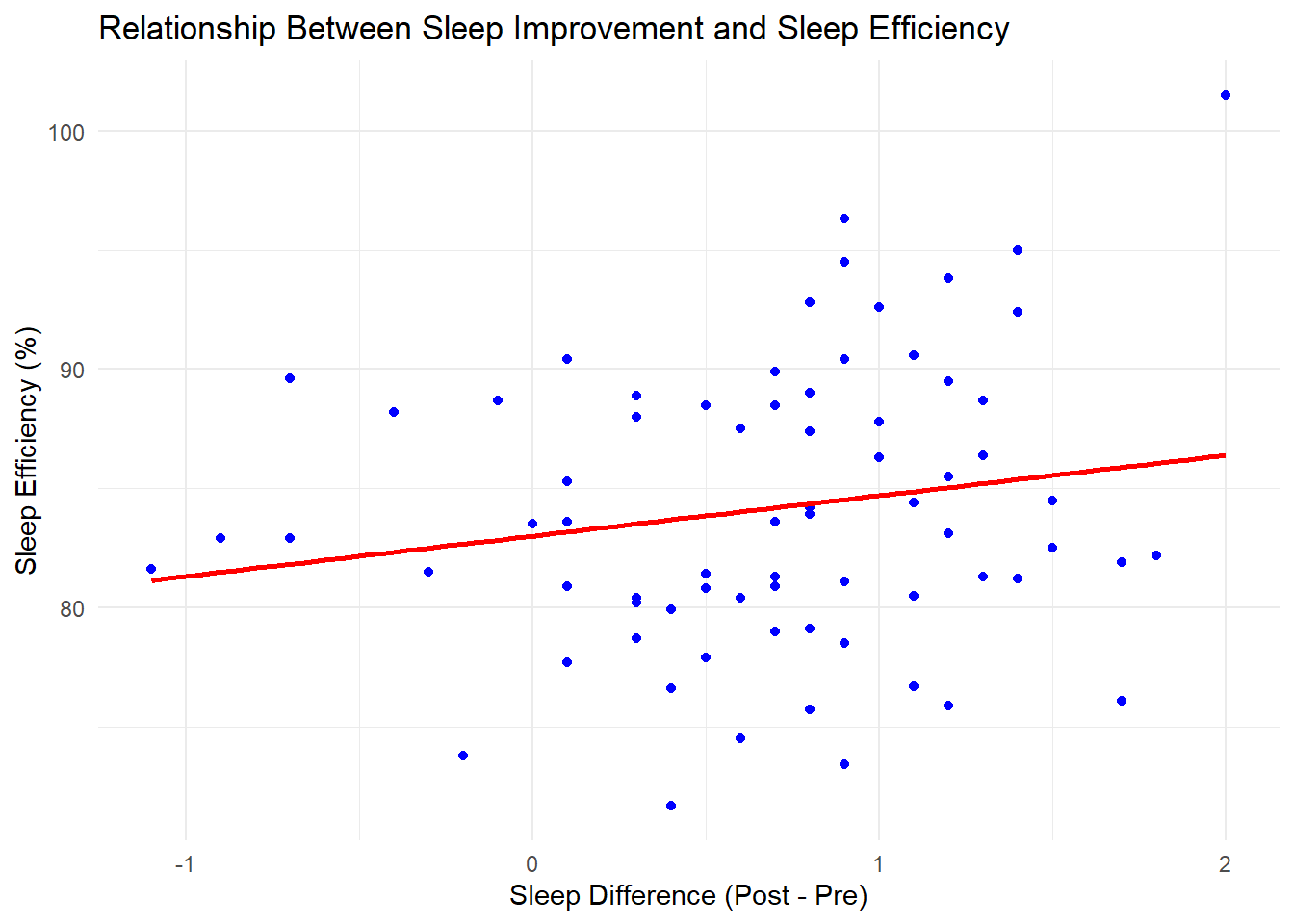
Figure 4.3: Sleep Improvements and Sleep Efficiency
4.5
##
##  Welch Two Sample t-test
##
## data:  sleep_difference by sex
## t = 1.3852, df = 64.335, p-value = 0.1708
## alternative hypothesis: true difference in means between group Female and group Male is not equal to 0
## 95 percent confidence interval:
##  -0.09075179  0.50135785
## sample estimates:
## mean in group Female   mean in group Male
##             0.775000             0.569697
#Age
t_age <- t.test(sleep_difference ~ agegroup2, data = merged_data %>% filter(!is.na(agegroup2)))
t_age##
## Welch Two Sample t-test
##
## data: sleep_difference by agegroup2
## t = -1.357, df = 40.85, p-value = 0.1822
## alternative hypothesis: true difference in means between group <40 and group >=40 is not equal to 0
## 95 percent confidence interval:
## -0.45511702 0.08932755
## sample estimates:
## mean in group <40 mean in group >=40
## 0.6421053 0.8250000Females (M = 0.78, SD = 0.59, n = 40) vs Males (M = 0.57, SD = 0.67, n = 33): p = 0.17. not significant
Age: Younger than 40 (M = 0.64, SD = 0.67, n = 57) vs Age: Forty years or older (M = 0.83, SD = 0.40, n = 16): p = 0.18. not significant
anova_sleep_diff <- aov(sleep_difference ~ exercise_group, data = merged_data)
summary(anova_sleep_diff)
## Df Sum Sq Mean Sq F value Pr(>F)
## exercise_group 4 9.061 2.2653 8.02 2.34e-05 ***
## Residuals 68 19.206 0.2824
## ---
## Signif. codes: 0 '***' 0.001 '**' 0.01 '*' 0.05 '.' 0.1 ' ' 1## For one-way between subjects designs, partial eta squared is equivalent
## to eta squared. Returning eta squared.## # Effect Size for ANOVA
##
## Parameter | Eta2 | 95% CI
## ------------------------------------
## exercise_group | 0.32 | [0.15, 1.00]
##
## - One-sided CIs: upper bound fixed at [1.00].## Tukey multiple comparisons of means
## 95% family-wise confidence level
##
## Fit: aov(formula = sleep_difference ~ exercise_group, data = merged_data)
##
## $exercise_group
## diff lwr upr p adj
## Cardio-C+W -0.1294118 -1.026386819 0.76756329 0.9942482
## N-C+W -0.8000000 -2.159530534 0.55953053 0.4720308
## None-C+W -1.0133333 -1.955243717 -0.07142295 0.0287638
## Weights-C+W -0.4894737 -1.414711770 0.43576440 0.5772427
## N-Cardio -0.6705882 -1.754206665 0.41303019 0.4203454
## None-Cardio -0.8839216 -1.345549991 -0.42229315 0.0000102
## Weights-Cardio -0.3600619 -0.786642681 0.06651884 0.1375430
## None-N -0.2133333 -1.334430932 0.90776426 0.9835831
## Weights-N 0.3105263 -0.796600673 1.41765330 0.9338316
## Weights-None 0.5238596 0.009464793 1.03825451 0.0438730anova_sleep_eff <- aov(sleep_efficiency ~ exercise_group, data = merged_data)
summary(anova_sleep_eff)## Df Sum Sq Mean Sq F value Pr(>F)
## exercise_group 4 580.7 145.2 4.954 0.00145 **
## Residuals 68 1992.4 29.3
## ---
## Signif. codes: 0 '***' 0.001 '**' 0.01 '*' 0.05 '.' 0.1 ' ' 1## For one-way between subjects designs, partial eta squared is equivalent
## to eta squared. Returning eta squared.## # Effect Size for ANOVA
##
## Parameter | Eta2 | 95% CI
## ------------------------------------
## exercise_group | 0.23 | [0.07, 1.00]
##
## - One-sided CIs: upper bound fixed at [1.00].## Tukey multiple comparisons of means
## 95% family-wise confidence level
##
## Fit: aov(formula = sleep_efficiency ~ exercise_group, data = merged_data)
##
## $exercise_group
## diff lwr upr p adj
## Cardio-C+W -3.67745098 -12.813473 5.4585710 0.7912049
## N-C+W -8.93333333 -22.780654 4.9139870 0.3775963
## None-C+W -8.86666667 -18.460372 0.7270383 0.0835904
## Weights-C+W -8.80175439 -18.225646 0.6221370 0.0784124
## N-Cardio -5.25588235 -16.292936 5.7811713 0.6708789
## None-Cardio -5.18921569 -9.891072 -0.4873598 0.0232689
## Weights-Cardio -5.12430341 -9.469186 -0.7794209 0.0127670
## None-N 0.06666667 -11.352126 11.4854595 1.0000000
## Weights-N 0.13157895 -11.144918 11.4080760 0.9999997
## Weights-None 0.06491228 -5.174389 5.3042138 0.99999974.6
Interpretation:
Sleep Difference ANOVA: F(4,68) = 8.02, p < 0.001, η² = 0.32 - Exercise does significantly improve sleep.
Tukey: “None” < “C+W” and “Cardio”; other differences mostly NS.
Sleep Efficiency ANOVA: F(4,68) = 4.95, p = 0.0015, η² = 0.23 - exercise increases efficiency.
Tukey: No exercise is lower than cardio and weights and just cardio: Weights only was lower than cardio and cardio with weights, also, but not as much as no exercise at all.
Recommendation: Cardio and/or Cardio with weights workouts seem to work best to help improve sleep. People in these groups showed the largest sleep improvements, while those who didn’t exercise had the least sleep improvements. Based on this, cardio only or cardio with weights focused exercise routines are the best way to improve sleep quality, regardless of your age, which did not have significant results. Sex differences did not have significant results either. So if you want to sleep better, hit the gym!
Reflection: This midterm was pretty challenging, mostly because it took me about 12 hours to get everything done. I realized I need to work on managing my time better so I can easily pick up where I left off if I have to take a break. I also want to get a stronger understanding of R code in general so I can work more efficiently. Going forward, I plan to focus on pacing myself and really understanding my code to make future assignments run smoother.